What are Dangerous Goods?
Dangerous goods are substances or articles that pose significant risks to health, safety, property, or the environment during transport. These risks have led international bodies to establish rigorous regulations governing their handling and transfer, adapted to each mode of transport: maritime, land, and air.
Classification of Dangerous Goods: International 9-Class System
The universally accepted classification is that of the United Nations, used by the IMO for sea transport, the ADR for road transport, and the ICAO/IATA for air transport.
Class 1: Explosives
Includes substances and articles that can explode or detonate rapidly due to a chemical reaction. It is subdivided into six divisions:
1.1: Mass explosion hazard. 1.2: Projection hazard, but not mass explosion hazard. 1.3: Fire hazard and minor blast or projection hazard. 1.4: Minor hazard; effects confined to the package. 1.5: Very insensitive substances with mass explosion hazard. 1.6: Extremely insensitive articles with no mass explosion hazard.
⚠️ Not insured by Assek Europe.
Class 2: Gases
Comprises compressed, liquefied, or dissolved gases under pressure. It is divided into:
2.1: Flammable gases (e.g., propane, butane). 2.2: Non-flammable, non-toxic gases (e.g., nitrogen, helium). 2.3: Toxic gases (e.g., chlorine, ammonia).
Class 3: Flammable Liquids
Includes liquids with a low flash point, such as gasoline, alcohols, and paints. These liquids can ignite easily in the presence of an ignition source.
Class 4: Flammable and Reactive Solids
4.1 Flammable solids (red phosphorus). 4.2 Spontaneous combustion (activated carbon). 4.3 Dangerous when wet (metallic sodium).
Class 5: Oxidizers and Peroxides
5.1: Oxidizing substances that may cause or contribute to the combustion of other materials (e.g., ammonium nitrate). 5.2: Organic peroxides, which are thermally unstable and may decompose explosively (e.g., benzoyl peroxide).
Class 6: Toxic and Infectious Substances
6.1: Toxic substances that can cause death or severe injury if inhaled, swallowed, or absorbed through skin contact (e.g., potassium cyanide). 6.2: Infectious substances that contain pathogens dangerous to humans or animals (e.g., contaminated medical samples).
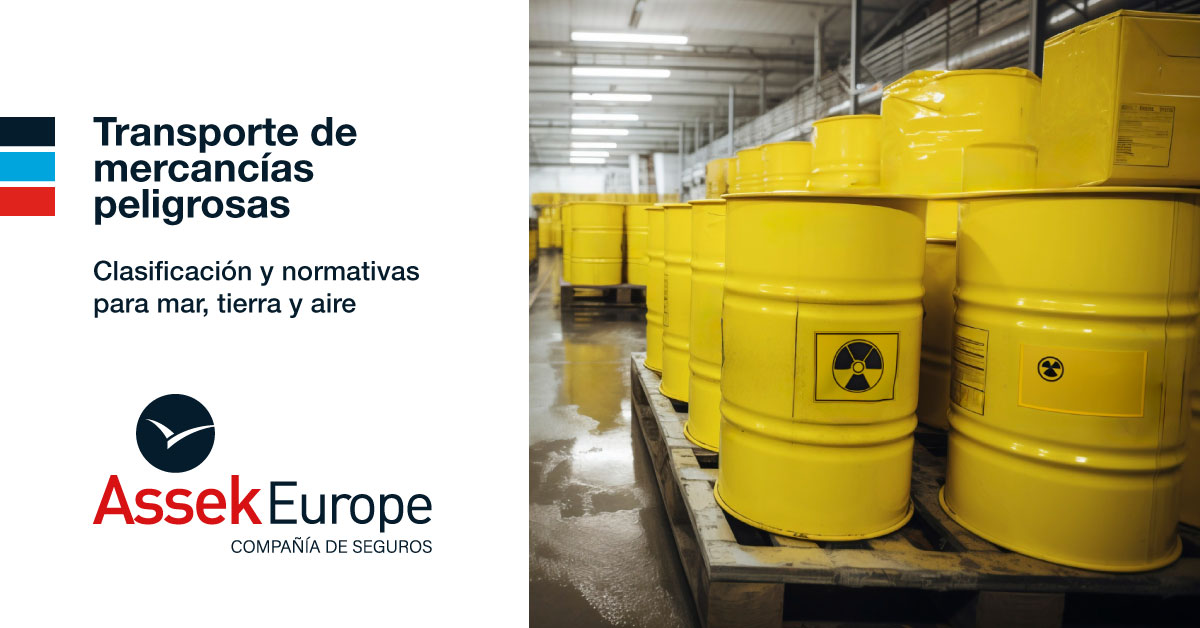
Class 7: Radioactive Materials
Nuclear or radiation-emitting materials, such as uranium or plutonium.
⚠️ Not insured by Assek Europe.
Class 8: Corrosives
Substances that can cause severe damage to living tissue or materials, such as strong acids (e.g., sulfuric acid) or strong bases (e.g., sodium hydroxide).
Class 9: Miscellaneous Dangerous Goods
Includes goods that present a danger during transport but do not fit into the previous classes, such as lithium batteries, environmentally hazardous materials, or dry ice.
Maritime Transport: IMDG Code
The IMDG Code (International Maritime Dangerous Goods Code) establishes the requirements for packaging, marking, labeling, and documentation for safe transport by sea. It is mandatory for all shipping companies operating under the IMO's SOLAS regulation.
Consult IMDG Code - IMO
Land Transport: ADR Regulation
The ADR Agreement regulates the international transport of dangerous goods by road in Europe. It sets requirements for driver training, vehicles, signage, documentation, packaging, and route restrictions.
Official ADR Information - UNECE
Air Transport: ICAO/IATA Regulations
For air transport, Annex 18 of the Convention on International Civil Aviation and the ICAO Technical Instructions (Doc 9284) apply. These are implemented by most airlines through the IATA Dangerous Goods Regulations (DGR).
ICAO Instructions - ICAO IATA Regulations - IATA DGR
How Does Assek Europe Insure the Transport of Dangerous Goods?
At Assek Europe, we specialize in cargo transport insurance, including many of the dangerous goods classifications, except for Classes 1 and 7. Our coverages are adapted to the specific risks of each type of cargo.
What Policies Do We Offer?
-
Annual by Turnover: Covers all shipments within a year.
-
Open Policy by Declaration: You declare shipments, and the agreed coverage applies.
-
Isolated Shipments: Coverage for a single, specific transport operation.
Understanding the classification and regulations of dangerous goods is essential to ensure safe and legal transport. Assek Europe is your specialized insurance partner to protect your cargo in any mode of transport. Shall we talk?